Salman Adnan

inference-engine

LLM Inference Engine

Some software has to run an AI model and produce its reply token by token, a token being a word or part of one. This is that software, written from scratch. The hard part is serving a crowd at once from a single machine without it sitting idle: memory housekeeping and clever turn-taking. On CPU, serving eight at once lifted it from about 45 tokens a second to about 114.

CPU numbers, read as relative

Runs GPT-2 family models on CPU. Hugging Face is used only to download weights; the forward pass, attention, cache, and scheduler are all implemented here. The benchmarks are single-machine CPU numbers and are honest about what they are.
Paged Attention: the memory trick this engine is built on, animated. Each thread is one person's conversation and the lattice is the model's memory of it, cut into fixed-size pages so many conversations can share one machine; the ghosts racing ahead are guesses at the next words, kept only if they turn out right. Live and interactive: drag it to orbit, scroll or pinch to zoom. Open full screen
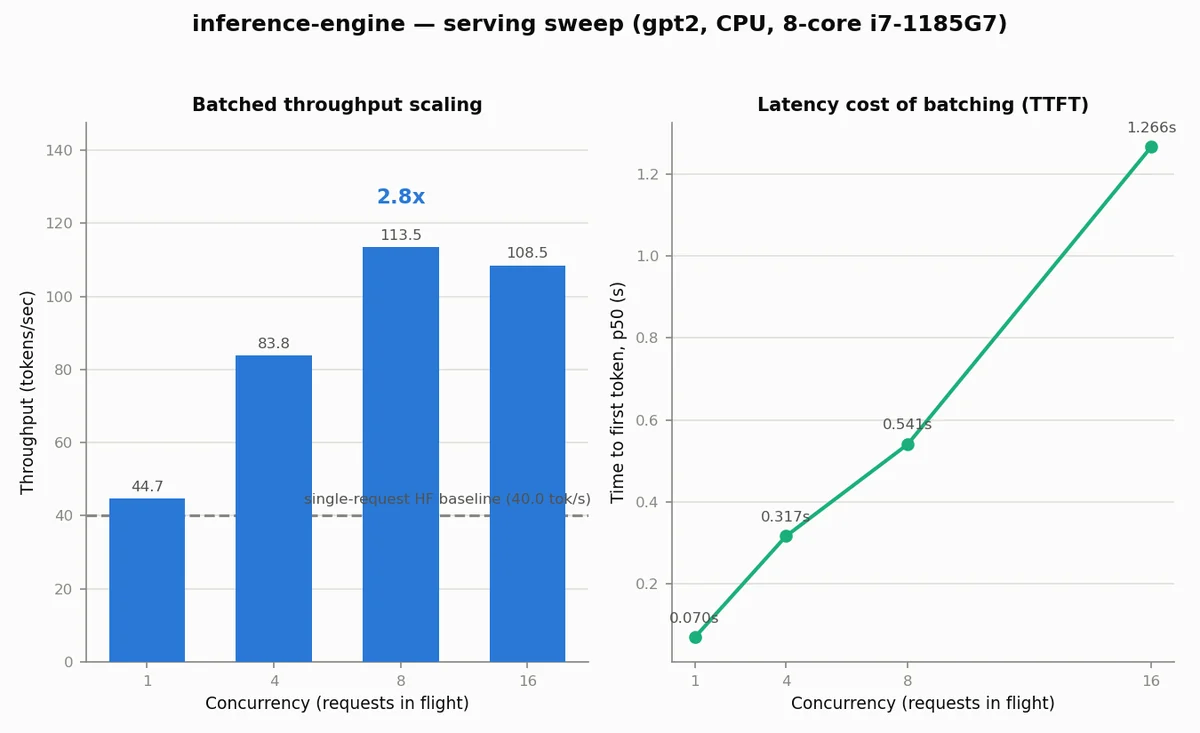
Two-panel chart of inference-engine's real serving-sweep benchmark: throughput scaling and time-to-first-token cost of batching.
Measured on an 8-core CPU: peak throughput reaches 113.5 tok/s at 8 concurrent requests, about 2.8x the 40.0 tok/s Hugging Face baseline.
~3e-5max logit diff vs transformers
~2.8xbatched vs sequential throughput
0.54speculative acceptance rate
55tests passing

Problem, solution, result

Problem: LLM inference is latency-bound in production. Serving multiple requests efficiently requires careful memory management, scheduling, and algorithmic tricks. Solution: Built a from-scratch inference engine with paged KV cache, continuous batching, prefix caching, and speculative decoding. Result: ~2.8x throughput improvement on commodity hardware through smart resource allocation, not raw compute.

The Problem

Production LLM serving is constrained by latency and memory. Naive request handling (one request at a time) leaves compute idle. Serving engines solve this through continuous batching, but require careful memory management: cache allocation, eviction, sharing, and rollback under failure. Serving engines are where ML meets systems programming: memory allocators, schedulers, cache coherence, admission control.

The Solution

Built a from-scratch LLM serving engine in Python and PyTorch that implements the core mechanisms needed for efficient inference:

  • Paged KV cache: Fixed-size 16-token blocks with refcounting, per-sequence block tables, and copy-on-write for shared blocks.
  • Prefix caching: Identical prompts reuse cached blocks with content hashing and LRU eviction.
  • Continuous batching: Requests join/leave at token boundaries; preemption lets new requests proceed when memory is full.
  • Speculative decoding: Smaller model drafts tokens, larger model verifies all at once with rejection sampling.
  • Verified correctness: GPT-2 implementation verified against transformers library to 3e-5 max logit diff.
  • OpenAI-compatible API: FastAPI server with /v1/completions, streaming, /models, /healthz, /metrics.

Results: Measured Throughput

Measured on an Intel i7-1185G7 (8 threads), PyTorch CPU float32, greedy decoding, 32 new tokens per request.

Throughput vs concurrency

ConcurrencyThroughput (tok/s)TTFT mean (s)
144.70.07
483.80.27
8113.50.54
16108.51.27

Interpretation

At equal settings the engine matches Hugging Face one-at-a-time (44.7 vs 40.0 tok/s) and reaches about 2.8x throughput once batching 8 requests (113.5 tok/s). The gain is pure scheduling and memory efficiency, not faster math.

Speculative decoding is correct (identical greedy output, 54% of drafts accepted) but about 0.7x slower on CPU, where the draft forward is not cheap relative to the target. It stays in the codebase as a correctness-verified feature. A comparison against vLLM is deliberately absent because this machine has no GPU, these are honest CPU numbers.

Technical Details

Tech stack:

  • Python
  • PyTorch (CPU)
  • FastAPI
  • SSE streaming
  • GPT-2 / distilgpt2
  • pytest: 55 tests, covering block-manager allocation and refcounting, the scheduler, sampling, logit parity against Hugging Face, speculative decoding, and the streaming HTTP API.

What Was Learned

  • Paged attention is bookkeeping, not math: The attention kernel barely changes; the allocator, refcounting, and hashing are where the design lives.
  • Continuous batching works, even on CPU: going from 1 to 8 concurrent requests lifts throughput from 44.7 to 113.5 tok/s, about 2.5x its own single-request rate and about 2.8x the 40.0 tok/s Hugging Face baseline. The gain comes entirely from not wasting compute on padding.
  • Measure honestly on your hardware: Speculative decoding's speedup is conditional on draft ≪ target cost. On CPU it goes backwards, more useful to know than to assume GPU numbers transfer.
  • Correctness first, performance second: Prefix-cache correctness with in-place rewrites required deregistering content hashes before mutation. Cumulative capacity checks had to span the whole batch, not per-sequence.
  • Tokenizer boundaries matter: UTF-8 can split across tokens in byte-level BPE, so detokenization must hold back partial tails until they decode cleanly.

Book a call

Let's talk about what you're building.

Pick a slot below. No forms, no back-and-forth emails.