Salman Adnan

n8n-automations

N8N Automations

Businesses run on repetitive chores: scraping leads, chasing enquiries, sending invoices. n8n lets you build a chore as a flowchart of connected boxes that then runs itself, no code required. This is 59 such automations built for Digitalise Agency, each documented honestly, faults included: one supposedly eight-stage email campaign had only its first stage actually wired up. Real, still-working account keys found in the files were stripped.

Digitalise Agency automations, curated and documented (2026)

Each workflow was pulled from the agency's live n8n instance or its on-disk exports, checked for real secrets and client-identifying data, scrubbed, and given its own README covering what it does, its architecture, and honest limitations found by tracing the actual node graph. A few names and course/tutorial-creator handles are withheld or corrected where the live workflow name was misleading or attributed to a third party.
The Automation Web: an artwork of what 59 automations look like side by side. Each node is one step, a trigger fires and sends work branching along the wires, and the sweeping wave is the clock starting the ones that run on a schedule. Live and interactive: drag it to orbit, scroll or pinch to zoom. Open full screen
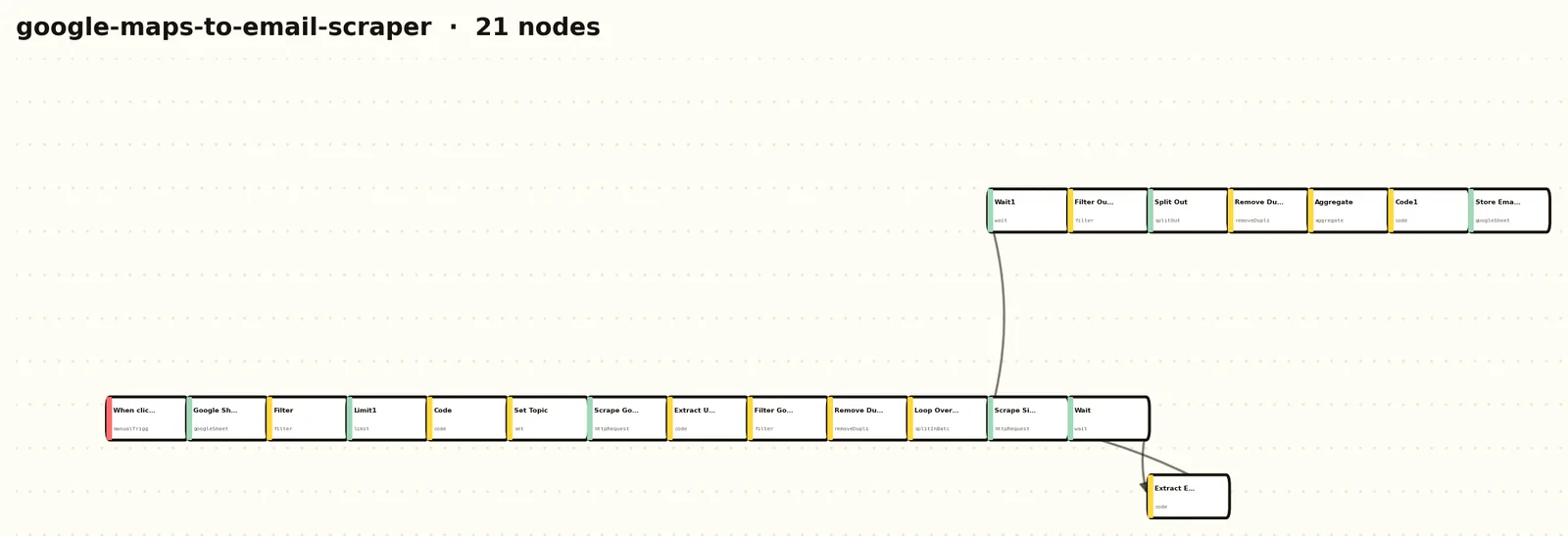
The real node graph of the google-maps-to-email-scraper automation: 21 nodes, exact names, types, and positions read straight from its workflow.json.
google-maps-to-email-scraper's real node graph, rendered from its own workflow.json (not a screenshot, but every node name, type, position, and connection is exactly as exported).
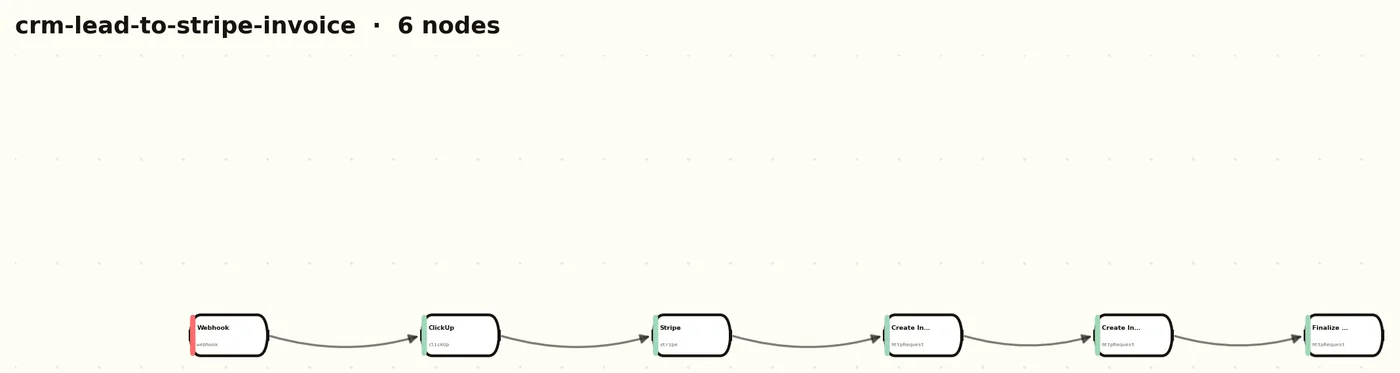
Real node graph of crm-lead-to-stripe-invoice: a simple 6-node linear pipeline from webhook to Stripe to invoice creation.
crm-lead-to-stripe-invoice, 6 nodes: the simplest end of the collection.
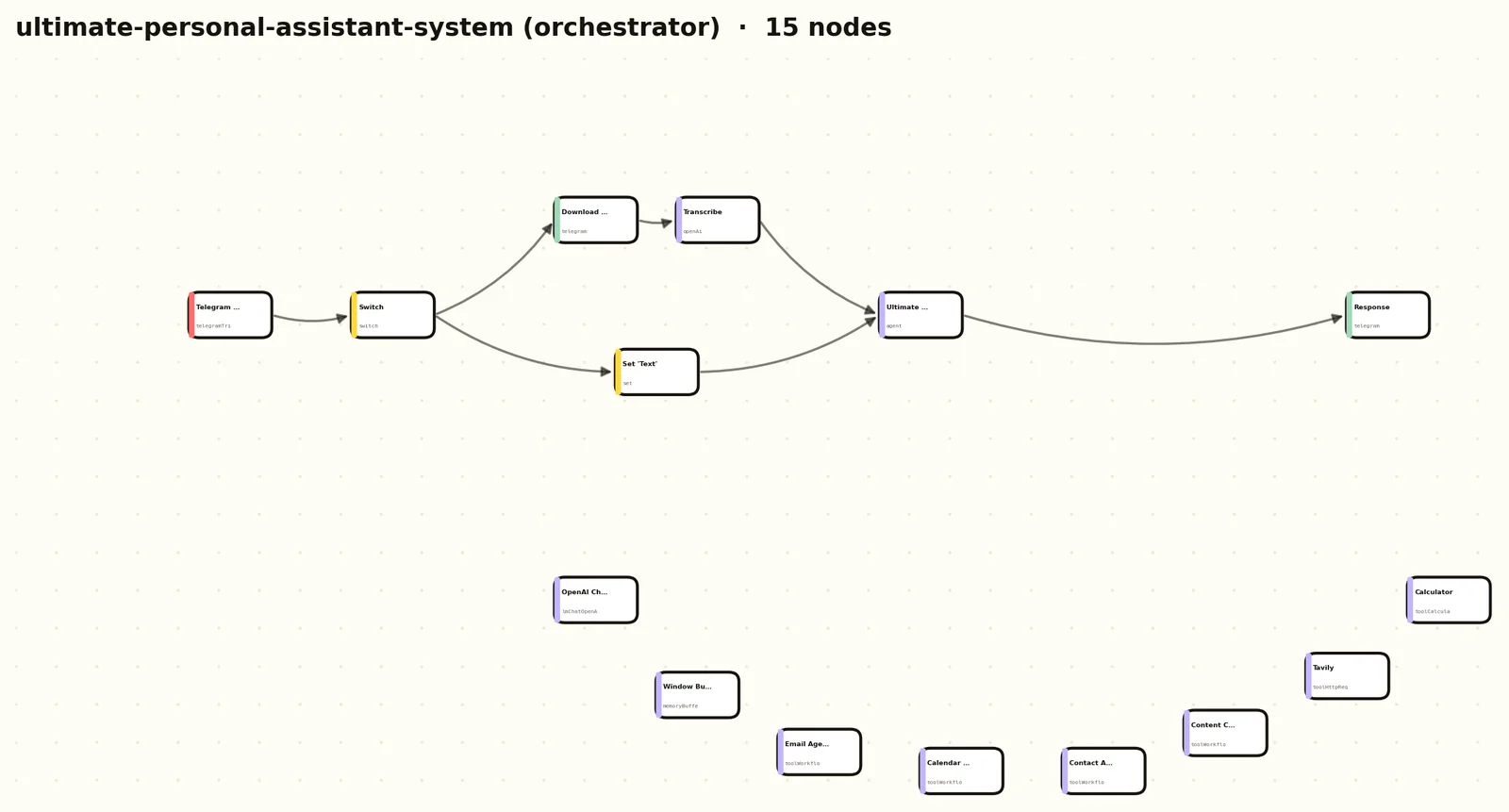
Real node graph of the ultimate-personal-assistant-system orchestrator: a Telegram trigger routing through a switch to voice transcription or text, into one agent, out to four tool sub-workflows.
ultimate-personal-assistant-system's orchestrator, 15 nodes, routing to four tool sub-workflows.
Real node graph of google-maps-to-email-scraper, a 21-node lead-scraping pipeline.
google-maps-to-email-scraper, 21 nodes.
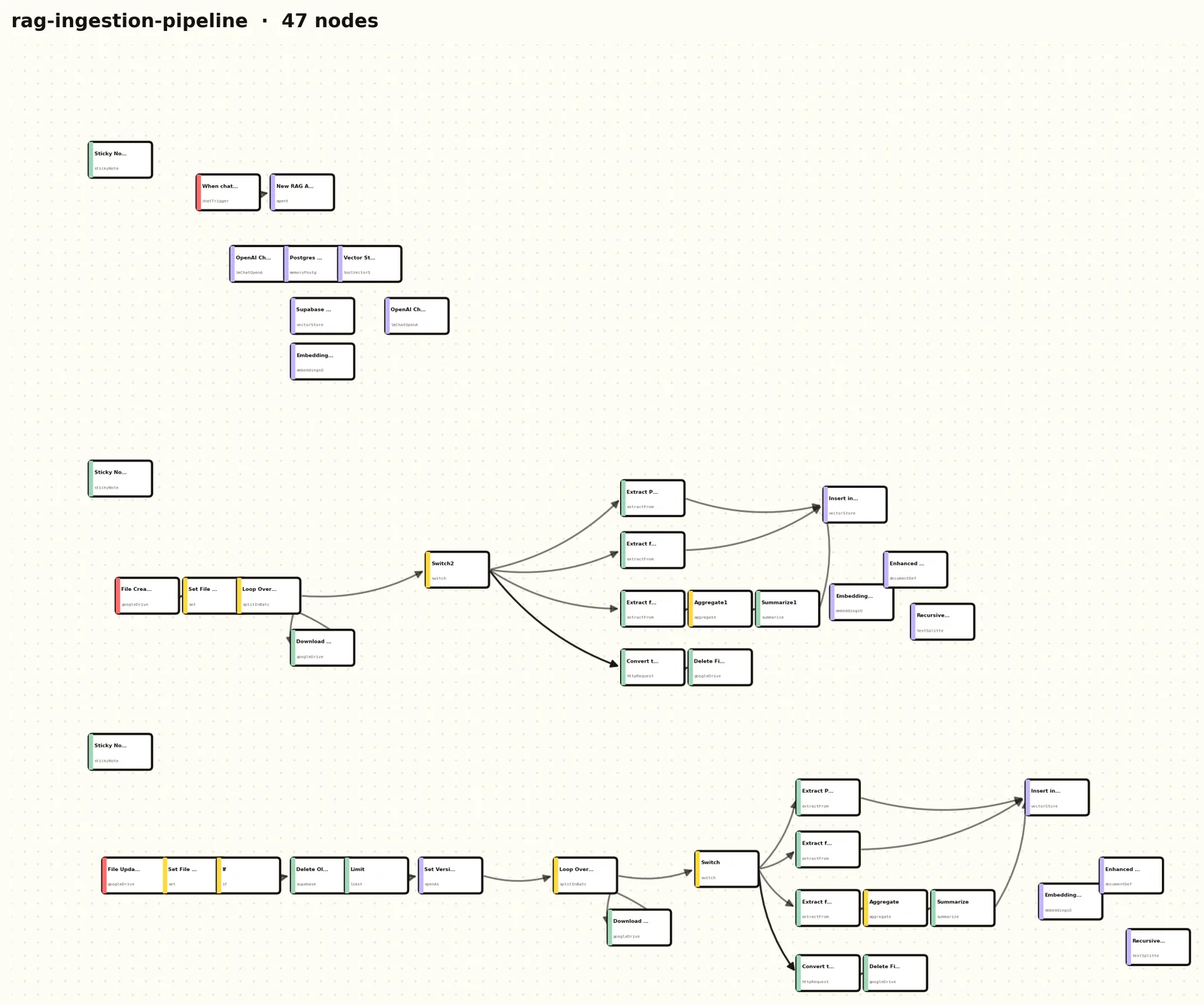
Real node graph of rag-ingestion-pipeline, 47 nodes feeding a vector store.
rag-ingestion-pipeline, 47 nodes.
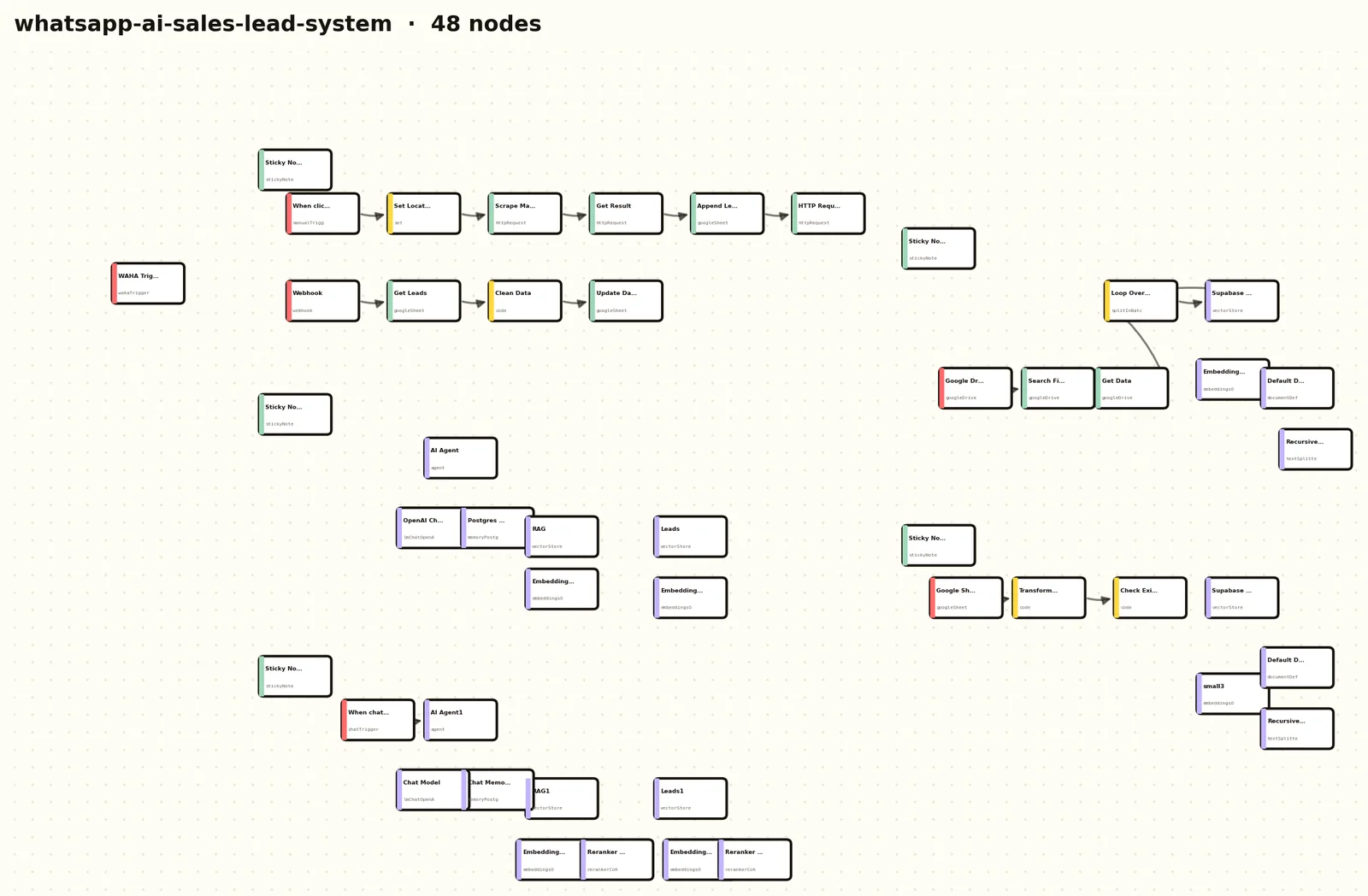
Real node graph of whatsapp-ai-sales-lead-system, 48 nodes. Several clusters sit visibly disconnected from the main flow, matching the real, documented defect in this workflow: the WAHA trigger and a Cohere reranker are wired but not connected to the live path.
whatsapp-ai-sales-lead-system, 48 nodes. The visibly disconnected clusters are real, not a rendering artifact: see this project's README for the documented WAHA-trigger and reranker wiring gap.
59documented automations
0secrets left in the export
5still blocked, source inaccessible

Overview

A curated collection of n8n visual-workflow automations built for Digitalise Agency: lead generation and scraping, AI content and video pipelines, SEO and outreach systems, CRM and booking utilities. n8n builds automations as node graphs instead of text, but the engineering is the same, chaining triggers, API calls, LLM steps, and data transforms into a working system.

Digitalise Agency runs a live n8n instance with well over a hundred workflows built up over time: some production systems serving real clients, some demos, some abandoned tests. This project is the curation pass over that instance: survey every workflow, decide what is genuinely worth showing, pull its real definition, strip anything sensitive, and document it to the same standard as the rest of this portfolio, including the parts that do not work as advertised.

Six of the 59, as node graphs

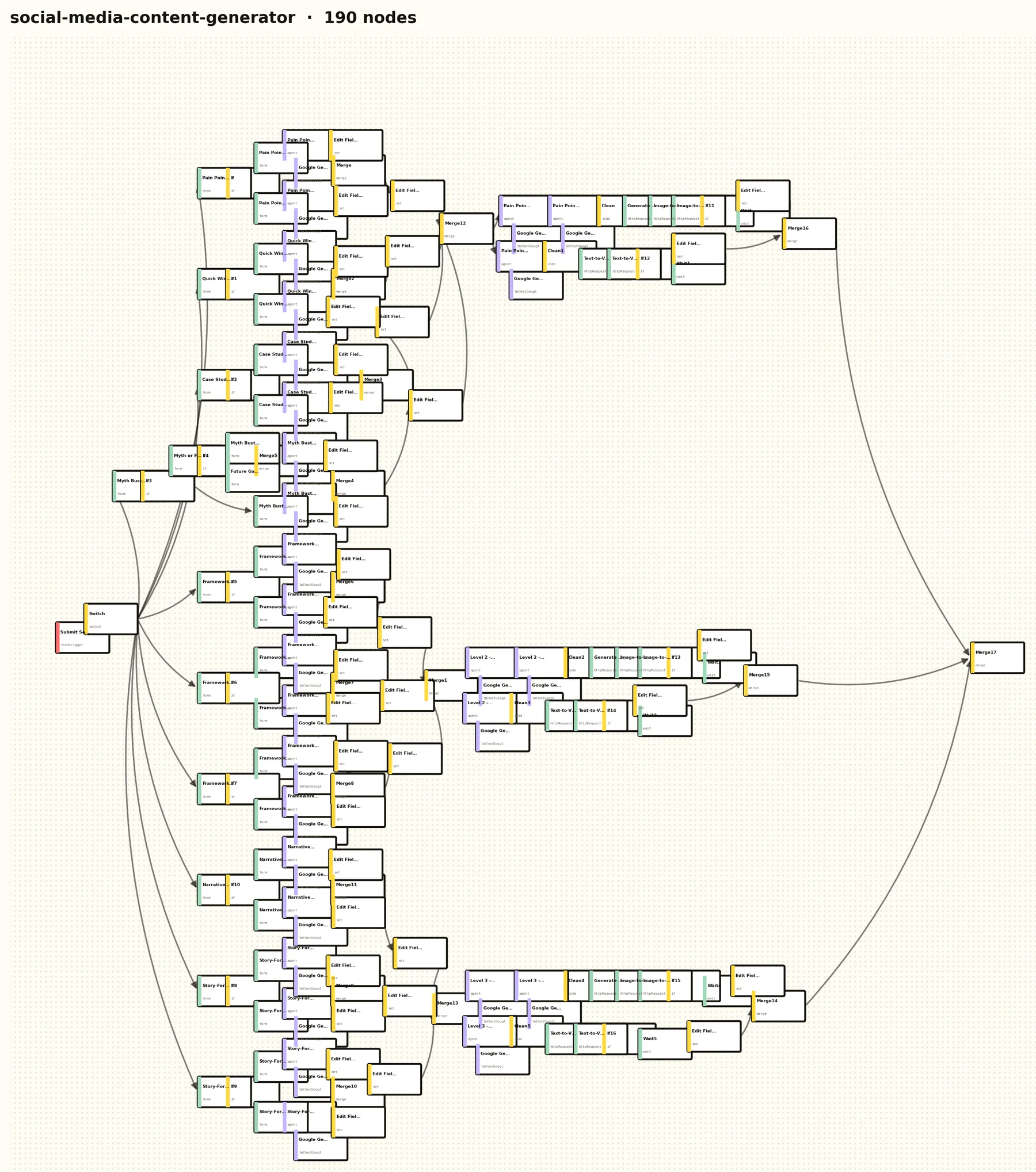
n8n builds automations visually, so a code snippet does not really show the work. These are not screenshots: each is rendered directly from that automation's real exported workflow.json, using its exact node names, types, canvas positions, and connections, colored by node role (trigger, AI/LLM, logic, action). Ranging from a 6-node utility to a 190-node content pipeline.
Key features

  • Lead generation and outreach: Google Maps business scrapers, a WhatsApp AI sales lead system with a Supabase RAG knowledge base, Instagram and LinkedIn lead-enrichment pipelines, a multi-stage cold-email sequence system.
  • AI content pipelines: a faceless short-form video generator, an AI avatar video pipeline chaining ElevenLabs, HeyGen, an FFmpeg API, and Submagic captioning, a 190-node social media content generator, and several SEO blog-post generators.
  • Agent systems: a Telegram-triggered personal assistant that routes to four sub-agents, a RAG ingestion pipeline into a Supabase vector store, an Upwork proposal-generation pipeline with a diagram-generating sub-workflow.
  • Business operations: a Cal.com booking-and-reminder CRM pipeline, a CRM-to-Stripe invoicing workflow, booking-availability microservices across Calendly and Cal.com.
  • Every workflow ships as an importable JSON file plus a README, a CREDENTIALS.md listing what external accounts it needs, and a PolyForm Strict LICENSE.

Verification

Every one of the 59 folders was checked for the required README, LICENSE, and CREDENTIALS.md files, every workflow JSON was validated with a JSON parser, and the whole collection was grepped for known API-key patterns, live webhook secrets, and personal email addresses. The pass caught real, unrotated credentials in several original source files (an Instantly.ai key, a Perplexity key, two Apify tokens, a Blotato key, a Supadata key, a ScreenshotOne key, a Fathom webhook secret), scrubbed in every copy here and flagged for the agency to rotate at the source. It also surfaced real defects in the underlying automations rather than hiding them: disconnected branches, a video pipeline that never writes its result back to its own tracking sheet, an "8-stage" email sequence where only the first stage is actually wired up live.

Tech stack

  • n8n
  • OpenAI / Google Gemini
  • Supabase (pgvector)
  • Apify
  • Google Sheets / Drive
  • ElevenLabs
  • HeyGen
  • Stripe

A challenge worth noting

n8n's workflow export strips credential bindings but not the hardcoded values some nodes had accumulated over time: real API keys sitting in HTTP Request node parameters, real Google Sheet IDs cached in node configuration, and once, a personal email address baked into pinned test data. There is no single grep pattern that catches all of that; it took reading each workflow's actual node graph rather than trusting an automated scan alone, since a URL query parameter or a credential-store `name` field can carry a real secret in a shape no generic pattern anticipates.

Book a call

Let's talk about what you're building.

Pick a slot below. No forms, no back-and-forth emails.