Important data is kept on several computers at once so that if one dies, nothing is lost. The hard part is keeping them in agreement while messages vanish and machines crash, without ever ending up with two versions that both look correct. This builds that agreement from scratch, then attacks it: 5,000 randomly generated disaster runs, 564,170 recorded reads and writes, and the stored data never once contradicted itself.
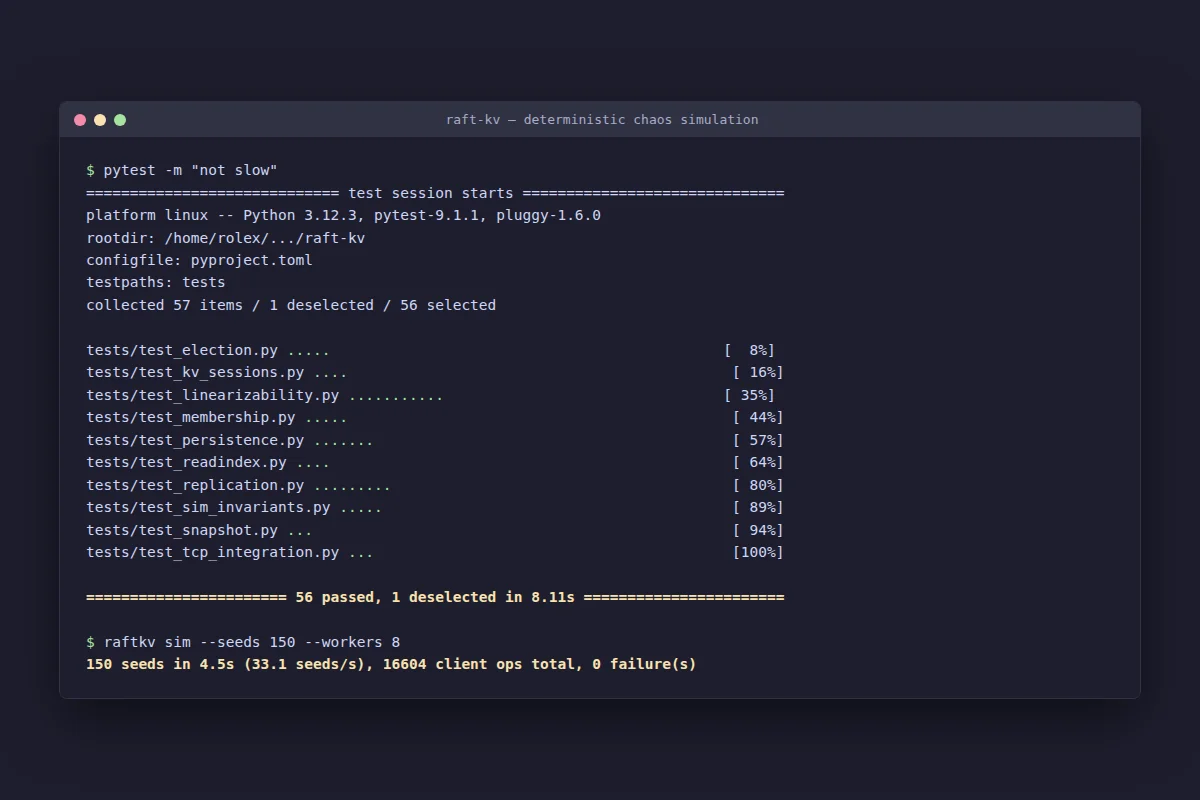
Consensus Ring: a handful of machines in a ring keeping one shared copy of the data in step. Heartbeats go out from the leader, changes replicate, the network splits in two, the survivors vote in a new leader, and the cluster knits itself back together. Live and interactive: drag it to orbit, scroll or pinch to zoom. Open full screenThe suite is 57 tests; this run deselects the one slow sweep, so 56 pass here. Below it: a 150-seed chaos sweep, 16,604 client ops, 0 failures.
A distributed key-value store with Raft consensus implemented from scratch in Python, plus a deterministic simulation harness that runs thousands of seeded chaos schedules against the real consensus code, and a from-scratch linearizability checker that verifies the client histories those runs produce.
Key features
Raft core: randomized-timeout leader election, log replication with fast conflict backoff, commit advancement restricted to current-term entries, fsync'd crash-safe persistence with torn-tail truncation, snapshot-based log compaction with InstallSnapshot, and single-server membership changes.
A KV state machine with get, put, delete, and cas, plus client sessions that deduplicate retried writes for exactly-once apply across leader failover.
Linearizable reads through ReadIndex with heartbeat-quorum confirmation and no clock assumptions.
Two transports behind one Env interface: asyncio TCP, and a deterministic simulated network with a virtual clock and seeded faults.
A linearizability checker (Wing and Gong search with Lowe-style memoization, per-key decomposition) that rejects known-bad synthetic histories.
Verification
pytest: 57 tests, including the paper's Figure 7 replication scenarios, torn-write recovery, membership changes over both transports, exactly-once failover retries, and real 3-node TCP cluster integration tests.
A long randomized run: 5,000 seeds in 84.7s, 564,170 client ops total, 0 failures. Each seed is 12 virtual seconds of a 3-node cluster under partitions, crashes, 5% message loss, 5% duplication, and election-timer skew, with every completed history checked for linearizability.
The harness has teeth: weakening the quorum rule makes the sweep detect split brain within a few dozen seeds.
A real kill -9 leader-failover demo with no data lost.