urdu-slm
Urdu Language Model, from scratch
AI text models are built around English and handle Urdu badly, chopping its words into far more pieces than needed. This one is built for Urdu from scratch: public Urdu text cleaned, a splitter taught to cut Urdu sensibly, then training on a rented GPU for about $13. It writes fluent Urdu in the correct script, but it is small, still drifting off topic and getting facts wrong.
A second base run (2026-07-08) added CC-100 Urdu and upsampled Wikipedia, about 7.7x more training tokens, on a rented A100 for roughly $13. Held-out perplexity improved from 38.02 to 28.93. Cloze accuracy moved from 34.9% to 39.5%, inside the small eval set's own noise margin, reported honestly rather than oversold. Real numbers and real sample generations from both runs are below.
Overview
A small Urdu language model trained from scratch: the full stack, from raw public text to a decoder-only transformer, built for a low-resource language that off-the-shelf tokenizers and models handle poorly.
Key features
- A streaming, resumable data pipeline that downloads and cleans public Urdu text into tokenized shards.
- A 32k byte-level BPE tokenizer trained on the cleaned corpus, with a measured compression comparison against GPT-2 on Urdu.
- A decoder-only transformer with RMSNorm, rotary position embeddings, SwiGLU, tied embeddings, and grouped-query-capable attention, in four presets (13.0M / 35.7M / 123.7M / 336.4M).
- A training loop with AMP, gradient accumulation, cosine LR with warmup, full resume, and single-GPU and DDP paths.
- Evaluation: held-out perplexity, a script-mix diagnostic, and a 95-item few-shot cloze harness.
Results
- v1 corpus: 3,695,487 raw units filtered and deduplicated to 2,515,082 documents (438.5M chars), 111.7M train tokens.
- v2 corpus: added CC-100 Urdu plus a newer Wikipedia dump, deduplicated to 13.3M documents. Two tokenized outputs: 862.4M-token main mix (Wikipedia upsampled 3x) and a 70.8M-token Wikipedia-only anneal set, about 7.7x more unique training tokens than v1.
- Tokenizer: on an 806,495-character held-out Urdu sample, the 32k Urdu BPE uses 4.078 chars per token; GPT-2 spends 5.23x more tokens on the same text.
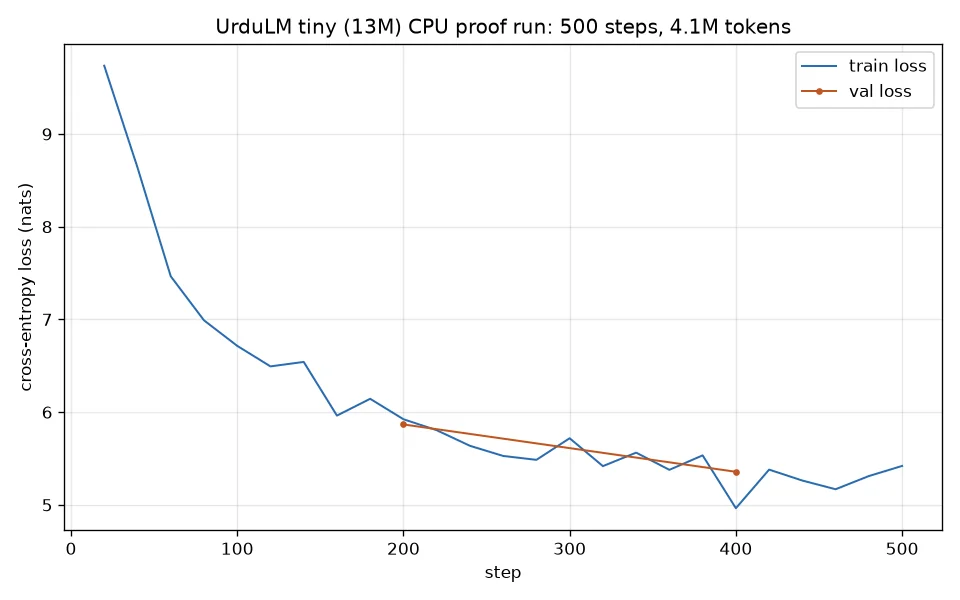
- Tiny proof run (13M preset, CPU, 500 steps, 4.10M tokens): train loss 9.74 to 5.42, held-out perplexity 248.8, and 98.2% of generated characters stay in Arabic script.
- Base run v1 (124M preset, A100, 858 steps, 449.8M tokens): loss 7.35 to 3.51, ~75 minutes, about $1.90. Held-out perplexity 38.02, script mix 99.43%, cloze 34.9%.
- Base run v2 (124M preset, A100, 4,768 steps, 2.5B tokens): loss 9.63 to ~2.74, real sustained throughput ~105,000 tokens/second, 6h 39m, about $13.06. Held-out perplexity 28.93, script mix 99.75%, cloze 39.5% (2-shot, chance is 33.3%).
- 13 tests passing (5 model, 8 pipeline), including a causal-masking property test and per-preset parameter counts.
Reading the base model honestly
Script mix confirms the model reliably writes in Urdu's actual script, near-perfect in v2 at 99.75%. The v2 corpus expansion produced a real, meaningful perplexity improvement (38.02 to 28.93), consistent with roughly 7.7x more unique tokens and a token-per-parameter ratio much closer to Chinchilla-optimal. Cloze accuracy moved from 34.9% to 39.5%, a 2-item difference on a 43-item eval set whose standard error is roughly 7 points, so this specific number is inside the noise band rather than a proven gain.
Why cloze barely moved despite a much bigger corpus: research on language model fact storage (Roberts et al., 2020) finds that how many discrete facts a model can retain scales mainly with parameter count, not training-text volume. A 124M-parameter model has a real capacity ceiling for factual recall regardless of how much prose it reads. More text raised fluency; it did not raise how many facts the model can store.
The eval set itself was also too small to trust: 45 items carries a standard error of roughly 7 points, wide enough to make a 2-item swing look like progress. It has since been expanded to 95 items (standard error roughly 5.2 points), and the v2 model's real score on the larger set is 45.2% (42/93, 2-shot), the new baseline for future comparisons. Two pieces are built and tested but not yet run: a 336M `medium` preset, and a Wikidata-derived declarative-fact training source (verified live against the public SPARQL endpoint, 890 real triples fetched, 865 surviving corpus-wide dedup), both aimed directly at the fact-storage-capacity ceiling above. A real, honestly-caveated cost estimate for that run is in the README: roughly $40-45 and 29 GPU-pod hours, not yet spent.
Three real v2 generations, shown as evidence rather than cherry-picked: a prompt about Pakistan drifts into religious-history fragments, grammatically fluent Urdu but topically disconnected, a different instance of the same drift seen in v1; a prompt about the Urdu language stays on-topic this time with coherent sentences about Urdu literature, an improvement over v1's repetition-loop failure on the same prompt; a prompt about today's weather produces fluent, topically relevant sentences about winter weather. The honest read: v2 is more fluent and holds topic longer in two of three samples, but topical coherence is still not reliable prompt-following, and factual recall did not move meaningfully, exactly what the fact-capacity research predicts for a corpus-only change at this model size.