cropbridge
CropBridge Team
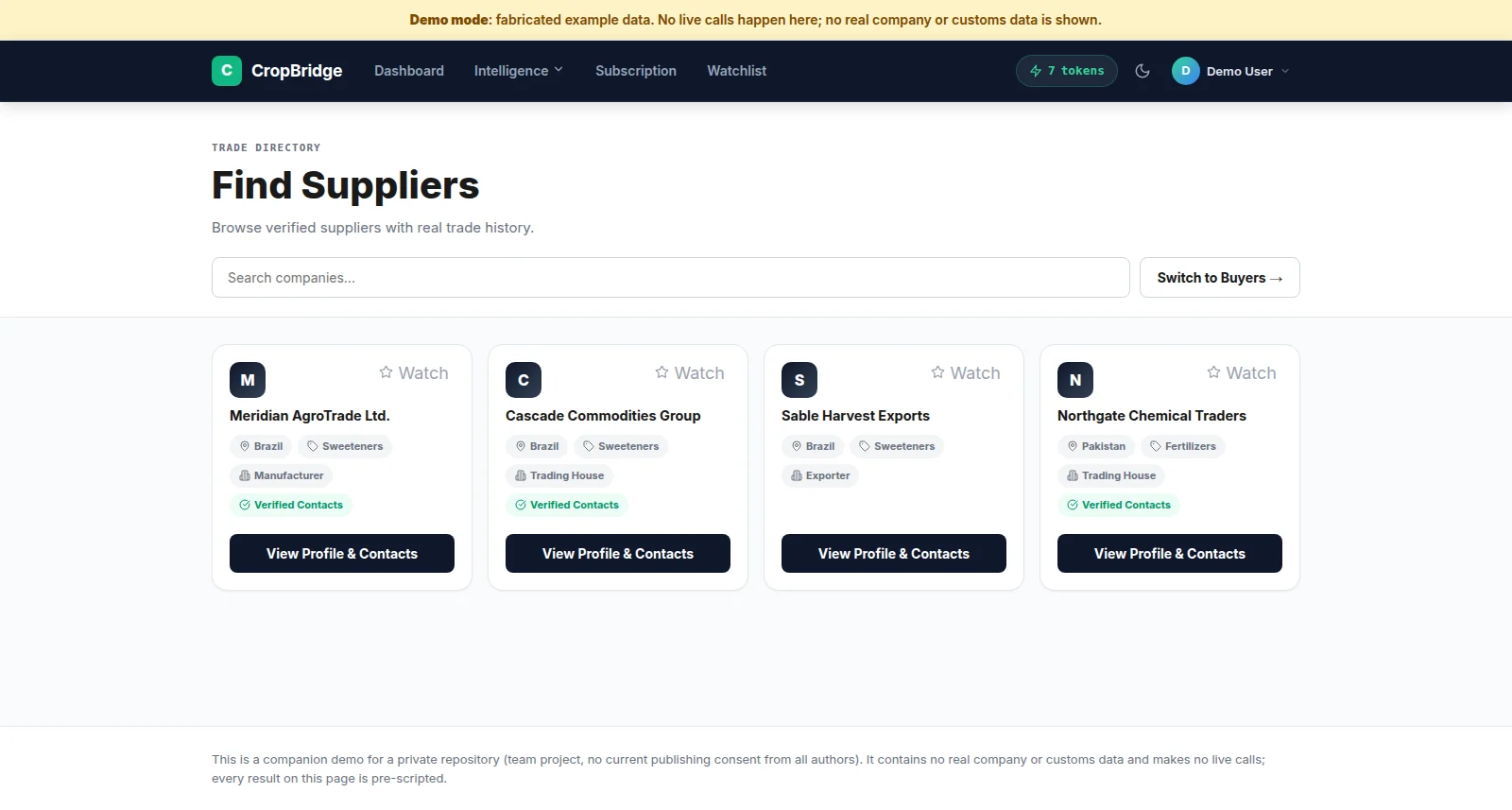
Suppose you trade farm goods and need suppliers of dextrose from Brazil under $800 a tonne. You type that question in plain words, typos and all, and this site searches Pakistani customs records for a ranked list of companies, with contact details locked behind a paid subscription. Three students built it as their final-year project, led by Salman; the demo runs on four made-up companies, not live customs data.
A three-person final-year project, originally built as ZaraiLink, made in collaboration with PAR (Pakistan Agriculture Research). Salman Adnan led it (64 of 97 commits), with Umar Kashif and Fahad Nadeem. Salman owned the database design, accounts and auth, the subscription and token economy, the admin dashboard, Trade Ledger and Market Pulse, GNN graph building, and frontend integration. Its source is private since it's shared team work and publishing it isn't Salman's call to make alone; available on request. The linked demo is a stand-in for it: the same search-to-ledger flow, on four made-up companies.
Overview
An agricultural trade-intelligence platform built as a final-year project at Habib University. It sits on Pakistani customs trade data and answers plain-language supplier queries through an NLU pipeline, a hybrid retrieval layer, and a learning-to-rank model.
Key features
- Natural-language search for buyers and suppliers, handling typos, mixed intent, price constraints, and country mentions.
- A Trade Ledger aggregating company activity from customs transactions (volumes, average prices, partners, growth).
- A company directory with sector filtering and similar-company suggestions (fuzzy matching plus node2vec embeddings over trade graphs).
- Subscriptions and a token economy with per-contact access gating, enforced server-side.
- HS-code and category search alongside free-text queries.
How the search works
- Intent (BUY/SELL): a SetFit few-shot classifier on a MiniLM base, trained on about 350 labelled queries.
- Entities: GLiNER zero-shot NER plus pycountry country resolution and regex price and quantity parsing.
- Retrieval: PostgreSQL trigram similarity (pg_trgm) plus sentence-transformer embeddings.
- Ranking: a LightGBM LambdaMART learning-to-rank model.
Results
- 63 backend tests and 49 frontend tests passing.
- Led by Salman Adnan (64 of 97 commits); the team also ran an end-of-project QA audit that is honest about the remaining security issues.